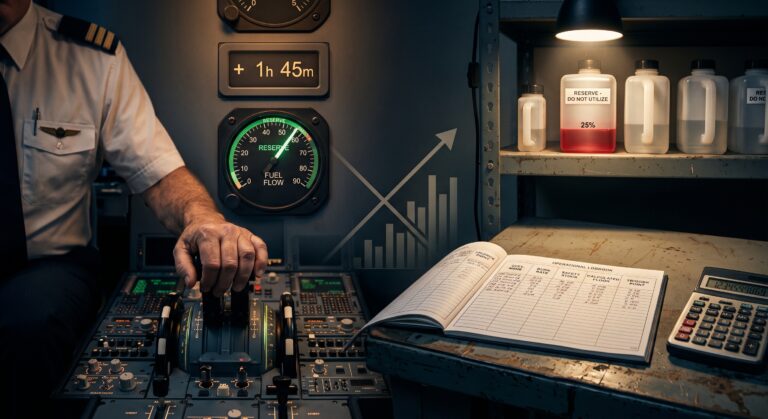
Three critical failures hit a vessel mid-charter simultaneously: the galley reefer alarms, a provisioning shortfall threatens tonight’s guest count, and the interior team is short-handed due to seasickness. Every station scrambles to solve its own crisis, and the entire operation loses its cohesion precisely when guests expect seamless perfection.
Having spent two decades in F&B and maritime hospitality, I have witnessed this exact maritime crisis management paralysis everywhere high-pressure execution is required—on a restaurant line during a walk-in failure or in a warehouse during a system outage. It happens whenever multiple crises strike at once, leaving teams frozen, unsure where to direct their focus. Yet, commercial pilots are rigorously trained on a simple three-word sequence that neutralizes this exact operational breakdown, a protocol virtually unknown outside the aviation industry.
Where “Aviate, Navigate, Communicate” Comes From
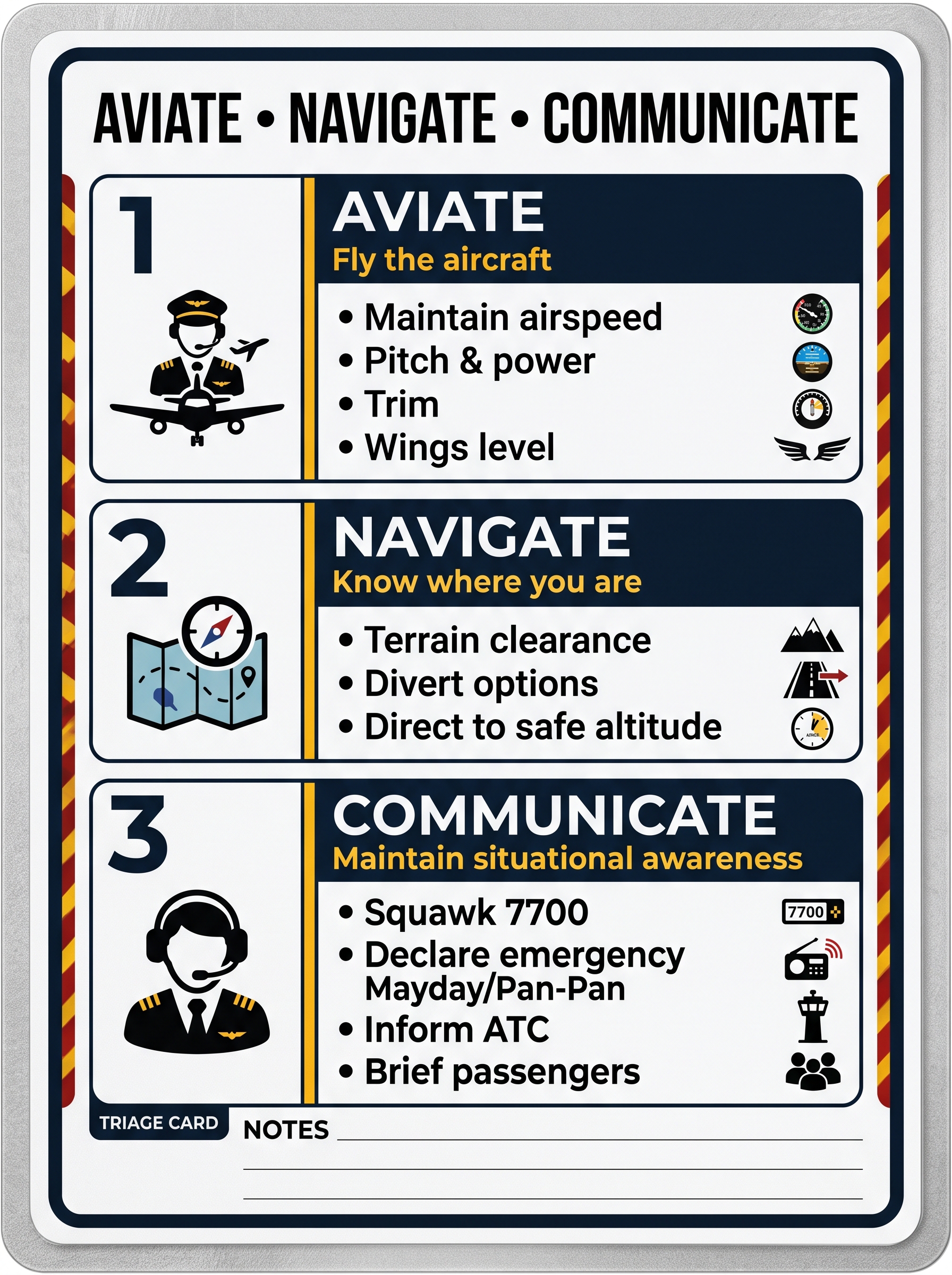
It’s not a metaphor pilots invented for teaching purposes — it’s the actual priority order drilled into every student pilot for handling an in-flight emergency, in this exact sequence, every time:
- Aviate — fly the airplane. Whatever else is happening, the aircraft stays under control first.
- Navigate — know where you are and where you’re going next.
- Communicate — only now, tell someone else what’s happening.
The order isn’t arbitrary, and it isn’t about which problem is most important. However, it’s about what the human brain can actually do under load. Under real stress, working memory narrows hard.
The FAA’s own human factors material describes it as attention collapsing onto whatever feels most urgent in the moment. It is frequently not what’s most dangerous. A pilot who keys the radio before stabilizing the aircraft is solving the wrong problem first. This means informing someone about a crash in progress instead of preventing it.
Aviate, navigate, communicate isn’t a checklist of three tasks. It’s a sequencing rule that keeps a stressed brain from doing all three badly at once.
The Same Failure, Different Deck
Strip the cockpit out of it, and the pattern remains identical when high-stakes work runs on tight margins. A vessel’s galley loses cold storage at the same moment the day’s provisioning order comes up short. A land-side kitchen’s walk-in fails during Saturday dinner service while a supplier no-shows.
In every version, the instinct is the same. Everybody grabs a different piece of the problem and talks about it immediately. The floor fills with information and empties of control.
What actually happens in these moments, almost without exception:
- Someone starts making calls or sending messages before the immediate hazard is contained.
- Two or three people try to fix different problems simultaneously with no one holding the whole picture.
- Nobody has actually confirmed the current state of the operation — just reacted to the loudest alarm.
None of that is a training failure or a character flaw. It’s what happens when a system asks people to aviate, navigate, and communicate all at once, with no sequence and no one assigned to hold it.
Applying the Framework Step by Step
Aviate — stabilize the platform first
However, before anything else, is the operation itself safe to run for the next five minutes? Moreover, in a vessel, the goal is to move food off heat quickly. This helps guests, before anyone messages the chief stew or captain.
On a land-side kitchen line, it’s the same move. In a warehouse, it’s getting product and people out of the path of whatever just failed. This step has one job: stop things from getting worse while you figure out what’s actually happening.
Navigate — know where you actually are
Once the immediate hazard is contained, assess reality instead of assumptions. What’s actually broken? What’s still working? What’s the real time pressure — is this an hour problem or a today problem?
This is the step most operations skip entirely, jumping straight from “something’s wrong” to “communicate,” which is how a five-minute equipment hiccup turns into a all-hands emergency because nobody paused to check how bad it actually was.
Communicate — now, and only now
With the platform stable and the picture clear, tell the people who need to know — in that order, not before. This mirrors the sterile cockpit rule almost exactly: non-essential chatter is suppressed during the highest-workload moments, not because communication doesn’t matter, but because premature communication actively competes for the same limited attention the crisis needs.
The Framework Across Verticals
The three steps don’t change. What “stabilizing the platform” means does, depending on what you’re running.
| Vertical | Aviate (stabilize) | Navigate (assess) | Communicate (now) |
|---|---|---|---|
| Maritime hospitality (galley/interior) | Get food and guests safe — off heat, out of a failed reefer, away from the disruption | Confirm what’s actually usable, real headcount and timing for the next service | Interior team to chief stew/chef, then captain or shore office |
| Hospitality / F&B | Get product safely off heat, out of temperature danger, away from guests | Confirm what’s actually unusable vs. salvageable, real ticket backlog | Kitchen to FOH, then GM/ownership |
| Warehousing / logistics | Clear people and product from the immediate hazard zone | Confirm what’s actually down — system, equipment, or both | Floor lead to shift supervisor, then customer-facing team |
| Remote facility / light manufacturing | Isolate the failure point, confirm no one’s at risk | Assess real production impact vs. perceived impact | Site lead to ops, then client/vendor if needed |
If You Recognize This Pattern
This isn’t about a tool — the sequence itself is the fix, and it costs nothing to adopt. But if the pattern above is one you’re living with regularly, it’s usually pointing at a specific systemic gap rather than a one-off bad shift:
- If it’s the same equipment failure creating the crisis repeatedly, that’s a maintenance readiness gap — we cover that ground in the Maintenance & Asset Readiness pillar.
- If it’s a supply or inventory shortfall triggering the scramble, that’s a demand forecasting gap — covered in the Inventory Discipline pillar.
- If the real problem is that nobody agrees on who does what during the crisis, that’s an SOP gap — covered in the Workflow Systematization pillar.
Create an Aviate-Navigate-Communicate Triage Card — a one-page, laminate-it-and-post-it version of this sequence, built for a kitchen pass, a bridge, or a warehouse office wall. You can adapt it with different actions according to your specific operation.
The Sequence, Not the Situation
Go back to that galley mid-charter, reefer down and the count short. The version of that team that’s actually drilled on this doesn’t start messaging the captain first — they get the food and the guests handled, take thirty seconds to know exactly what they’re actually working with, and only then make the call, once, with the full picture instead of a partial one shouted over three people talking at the same time.
The tool doesn’t fix this. The sequence does, every time, on purpose, before the next alarm goes off.
What’s the failure mode at your operation where everyone reaches for the radio before anyone’s actually stabilized the problem?