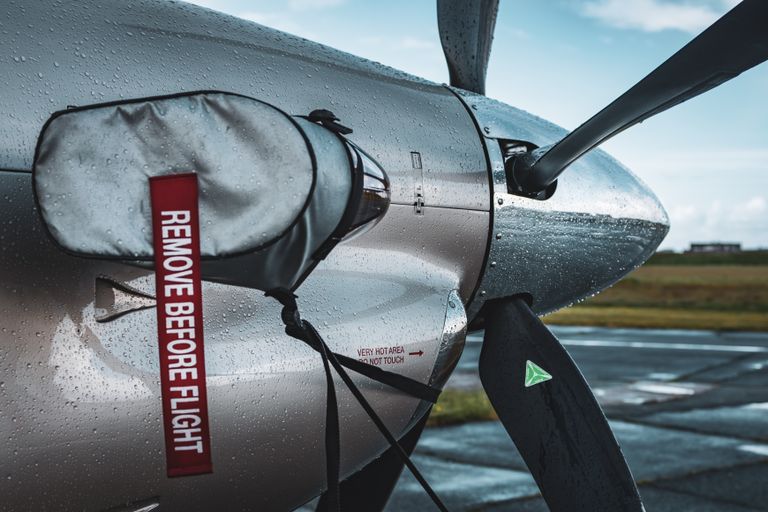

Twenty minutes early for a solo cross-country, I pulled the fuel sticks on my assigned aircraft. Additionally, it was well short of the flight plan, because someone had flown it earlier that morning. Thus, no one topped it off before I signed for it. That gap is the same I watched swallow restaurants and warehouses for almost twenty years. Long before I touched a yoke, it was the space between paperwork and what’s in the tank. Pilots are trained to catch that gap before they ever leave the ground, with a number, not a feeling. That is The Reserve Fuel Mindset. Most operators never get taught the number at all.
The Fuel Wasn’t the Problem. The Assumption Was.
Nobody had done anything malicious that morning. The aircraft had flown a lesson, come back, and gone straight back on the schedule. It was a completely normal turnaround. The kind that happens a dozen times a day at any flight school. The gap wasn’t a failure of honesty.However, it was a failure of handoff.
The assumption that someone else checks that quietly became nobody checks that.This reflects The Reserve Fuel Mindset.
Before that flight leaves the ground, a pilot asks if we have enough gas to make it. This reflects The Reserve Fuel Mindset; it requires fuel for the planned route plus a legally required reserve. Additionally, it assumes the flight won’t go exactly as planned, because it never does. Headwinds, a traffic hold, or a diversion due to weather can arise. The reserve isn’t for the flight you planned; it’s for the flight you’ll actually fly. That morning, the math didn’t work.
Additionally, before I did anything else, I refueled. I did this before checking weather again. Before reviewing the route one more time, I did this. Not because the tanks were empty. Because they weren’t full enough to survive a flight that may go wrong.
That’s the whole discipline in one decision. Not “will we probably be fine.” Will the numbers hold if the day goes sideways.
This is normally one procedure that is included in the pre-flight inspection checklist.
Every Operation Has a Tank Gauge. Most Never Learn to Read It.
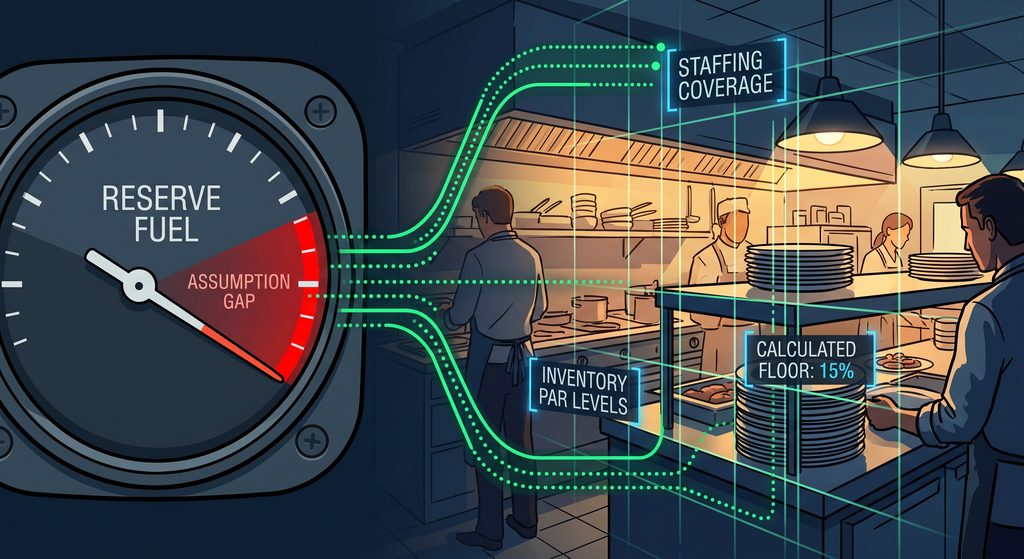
Walk onto any hospitality floor, into any warehouse, aboard any vessel, and there’s a version of that fuel gauge running quietly in the background — inventory levels, staffing coverage, cash on hand, spare parts for the equipment that can’t go down.
The difference is almost nobody treats it the way a pilot treats fuel: as a number calculated in advance, checked before the operation starts, with a mandatory floor nobody is allowed to plan below. Instead, most operators run on the fuel-gauge equivalent of “it was probably fine last week.” Moreover, they reorder when the walk-in looks low.
Additionally, they staff to the labor budget exactly, with zero slack for a call-out. They run one supplier because switching is a hassle. We don’t have a plan for what happens if that supplier has a bad month. None of that is stupidity. It’s the same failure that happened to my aircraft that morning.
That reasonable assumption quietly became an unmanaged gap. Consequently, nobody assigned a number to the buffer. Nobody checked it before the day started.
For example, the 2:00 a.m. version of this is always the same shape. Something ran out that someone assumed would still be there. Additionally, a walk-in with no protein for the Saturday rush. Moreover, a hotel down one housekeeper because nobody planned for a sick call. Furthermore, a vessel with a failed part and no spare aboard, three days from the port that stocks one. Nevertheless, in every case, the failure wasn’t unforeseeable. Thus, it was unreserved.
Mapping the Reserve: Where Aviation’s Math Applies Directly
| Aviation Reserve | What It Protects Against | Operational Equivalent | Where Operators Usually Skip It |
|---|---|---|---|
| Required fuel reserve | Running the tanks dry before you’re safely on the ground | Inventory safety stock / par level | “We’ll reorder when it looks low” — no defined trigger number |
| Alternate / diversion fuel | Destination airport closing or going below minimums | Backup supplier or secondary vendor | Single-supplier dependency with no fallback contract in place |
| Personal minimums (stricter than the legal floor) | The gap between what’s legal and what’s actually safe for this pilot, this day | Staffing buffer above the bare legal/budgeted minimum | Scheduling exactly to labor cost, with zero slack for a no-show |
| Preflight fuel calculation | Flying on hope instead of arithmetic | A real demand forecast instead of a gut-feel order | Ordering off last week’s numbers, memory, or “what usually happens” |
Notice the pattern: every row on the aviation side is a number, calculated before the operation starts. Every row on the operations side, when it fails, failed because it was a feeling instead.
The Reserve Buffer Worksheet
This is the part most operators skip entirely — not because it’s complicated, but because nobody ever framed it as a preflight step instead of an afterthought. The worksheet below does the same job a fuel calculation does before a flight: it forces a number onto something people usually just eyeball. It can also help evolve the reserve fuel mindset.
What the reserve buffer worksheet walks you through:
- Your daily burn rate for the resource that matters most — inventory, labor hours, or cash — calculated the same way a pilot calculates fuel burn per hour, not estimated.
- The required minimum reserve on top of that burn rate, sized to survive one bad day, not an average one.
- A contingency add-on for a known, foreseeable risk — a holiday weekend, a known-thin staffing week, a single-supplier category — the operational version of carrying extra fuel because the forecast shows weather near your alternate.
- A trigger point set above zero, not at it, the way a reserve fuel light comes on with usable fuel still in the tank, not at “empty.”
- A recheck cadence, because a reserve calculated once and never revisited is the same mistake as never calculating one — pilots re-run fuel planning every time conditions change, not once per aircraft.
Get the Reserve Buffer Worksheet — size your inventory, staffing, and cash reserves like a preflight fuel calculation.
Where This Breaks First
None of this requires software to start — the worksheet above works on paper, the same way a pilot can run fuel math with nothing but a kneeboard and a pencil. It breaks the moment the calculation depends on someone remembering to redo it by hand. That’s true whether the number lives in a notebook, a shared spreadsheet, or someone’s memory of “what usually happens.” A reserve that only exists in one person’s head isn’t a reserve. It’s a hope with a job title attached.
The fix isn’t a specific tool — it’s making sure the number gets recalculated on a schedule instead of when someone happens to think of it. Whatever keeps that cadence honest at your operation is the right instrument. What it’s called matters less than whether it gets checked.
The Number That Would Have Kept Me on the Ground
If the fuel math hadn’t worked that morning, I wasn’t flying — full stop, no negotiation, no “it’ll probably be fine.” That’s not a dramatic story. It’s the entire point. The reserve isn’t there to be interesting. It’s there so the interesting version of the day never gets the chance to happen.
Additionally, most operations don’t need a bigger warehouse, a better vendor, or a smarter forecast. Thus, they fix their 2:00 a.m. fires with it.
Moreover, they need a number they check before the day starts. They must treat that number as a floor, not a suggestion. Instead, the tool doesn’t build the reserve. Hence, the habit of checking it before you need it does.
What’s the number nobody at your operation has actually calculated yet — inventory, staffing, or cash?
I read you in the comments.